
BLOG 2015 - 1

Prepare for a more efficient New Year
As one year ends, another begins, and it’s a good opportunity to assess what has happened over the last year and consider what we can do to improve next year. Personally we tend to do new year’s resolutions, things like “I will not eat chocolate” or “I will go to the gym every week”. But a company can also have New Year’s resolutions too.
The first thing is to assess the problems and consider which one will have the biggest impact. In our experience the biggest impact on an operation is holidays. You might not think 28 or 33 days has much of an impact. But consider if the company has 10 employees all with 33 days of holiday in an office hours’ environment, that means that there are 330 days of holiday to accommodate and there are only 260 days when you are working. Clearly everyday at least one person has to be on holiday. So even with 10 people on average you are always operating one person down.
When you have shift workers the problem becomes even bigger because you need to think not only about the effect an absence has on the shift itself but also the impact to the adjacent shifts. Companies can quickly find that they are continually missing targets while their overtime bill is sky rocketing and they don’t know why! Yet when we analyse the operation, we always start with the holidays. A quick assessment of how holidays have been taken and are covered reveals that managers forget to consider the effect holidays make to the operation, so they haven’t got adequate cover in place or they have the cover but it is in the wrong place.
The Saving can be Substantial
Let’s go through a typical problem. You have 10 people on shift and you need 10 on shift to operate effectively. 10 people with 30 days of holiday is 300 days of holiday per shift. You have four shifts so that’s 1,200 days of holiday.
So here is some simple maths; if 40 people are on a 40-hour week with 30 days of holiday each, how many shifts is that if they are working 8-hour shifts?
Each day of holiday is one fifth of a working week, or 8 hours (40/5=8). If each shift is 8-hours then they each get 30 shifts off per year. Nice and simple.
If they are working 12-hour shifts, then they are each entitled to 20 shifts of holiday (each day is 8-hours so it’s 1.5 days of holiday for each shift).
So how many people do you need on each shift to fit in everyone’s holiday?
Sounds like a simple question, and most people would give the answer to be two. That’s because on average you have 1.15 of a person off each shift. So you would round up to two. That means that now you have 12 people on shift. So how many will be on holiday on the average shift? With 10 people the answer was 1.15, however when you increased the number of people you also increased the amount of holiday. So now you have 1.38 off each shift on average.
So is two the correct number?
Let’s look at what would happen over the year. So you have two extra people coming in each shift. So that’s 4,160 hours of holiday resource (2x40x52=4,160). That’s per shift, so in total, you have 16,640 hours of holiday resource. That’s a lot of hours.
You are covering 2,880 hours of holidays per shift or 11,520 hours for the operation. So that gives you a spare capacity of 5,120 hours or about 45% of the holidays.
So in theory yes two extra on shift would give you the correct number to cover for holidays.
However, in practice you run into problems. When do people like to take holidays?
- Summer
- Christmas
- Good weather
- Weekends
- School Holidays
People don’t take holidays like robots, they take holidays when it’s convenient to them. So during the summer and Christmas companies say, we recognize that people want to take more holiday so we will allow two people off every shift and then cover for a third with overtime.
Sounds like a good policy, however you have now given mangers carte blanc to use overtime to cover for absences and holidays.
From the manager’s point of view, they have a quota to meet so if they need to bring someone in on overtime, that is a small cost compared to missing their quota. So they bring someone in on overtime. Then have you ever tried to refuse someone’s holiday request. It’s not an easy thing, and now they have the resources to bring someone in on overtime. So what happens is during the summer it is not uncommon to only have half of the original shift in and half covered by overtime.
Hence while you started out with the correct number, you now find that you have a high overtime bill which is completely unnecessary.
So what’s the solution?
Well there are two, you can go down the route of a holiday management plan. This sets out the rules, to minimize the disruption that holidays cause. It’s very effective and when used correctly will ensure that you have the correct number on shift at all times.
However, it does require someone to manage it, at least one full time equivalent per fifty people. And really you should spread the job between three people, so that they can have holidays too.
The alternative is to introduce holidays included. Holidays included shift patterns are where everyone’s holiday is pre rostered into the shift pattern at the start of the year. This time is not randomly allocated, it is given in good quality chunks of time off in a way that the shift workers would like. So they have a week off regularly, and a two-week holiday in the summer. They always get whole weekends off or a minimum of three days between shifts. We’ve set up hundreds of holidays included shift patterns for companies around the world. So once a year you need to spend a week or so setting up next year’s shift pattern, and then that’s it. The shift pattern runs itself. So now you have no holiday problem.
If you would like to know more about holidays included follow this link
Or contact us directly at alec@oranalysts.com or by phone on (+44) 01636 816466 and find out how we can help you have a more efficient Happy New Year.

Problem Solving
The first question you should ask is: “What is your problem?” This is very often so hard to define that we look at the symptoms and not the root cause.
Take lifts. People used to complain that lifts (or elevators to Americans) were too slow. Everyone was always stuck waiting. So engineers tried to speed up the lifts. They got faster and faster, yet people were still complaining. So they started doing all these fancy models so that the elevators would travel to the most used floor or wait in the best location to minimize waiting time.
Yet people were still complaining. In the end somebody came at the problem from a different approach. They put up mirrors. Now people had something to do while waiting for the lift.
The problem was not that the lift was too slow, the problem was that people were bored.
So the next time you hit a problem don’t just try to fix a system, try to find the root cause and fix that. Sometimes it’s easier and cheaper.
When companies come to us saying that their current operation is no longer working, we always start with the most obvious problems. People are very good at seeing problems. We were designed to use our brains when we hit an obstacle; overcome it or go round.
When we are operating a business the same rules apply, we try to fix the current issue or if that’s too hard and expensive we remove the problem by cutting our losses.
Strangely enough most companies have the same root causes for all their staffing failures:
- Not enough staff
- Wrong skills mix
- Poor Holiday management
- Poor absence planning
- Change to the workload
The problem is that something has changed. When you start a business it takes time and a lot of trial and error to get everything running smoothly, but once it is you tend to forget about it. Then something happens. It may be small like somebody leaves or big like a change in the workload. So you go back and put in little fixes. Something happens again, and again and each time you don’t overhaul the whole operation, you just put in little fixes because it is easier and cheaper.
Until one day you look back and can’t remember why you did something on one occasion and something else on another. Then something happens and you don’t know what to do. That’s where we come in. We can look at your current system and assess it for staffing failures. Sometimes it just requires a few minor adjustments. Maybe a change to your procedures or implementing a new shift pattern.
On other occasions we may find that all your little fixes are making you inflexible for the future and you have a good opportunity to futureproof yourself. Put in a new way of working, with new shift patterns and flexible working arrangements. Think about contingency planning so that you know what to do when the next little problem comes up, don’t reinvent the system just look it up and then each time a common problem occurs you can solve it quickly, simply and cheaply.
Let us save you time and solve your problems contact us on alec@visualrota.co.uk or call (+44) 01636 816466 and find out how to solve your problems.
Pottering Around
Pottering around, what a wonderful phase. It means to do a gentle activity in a seemingly aimless manner. I love to potter around the house, doing this and that without any real obligation to get anything done. So while pottering you could read, play a game, and watch some TV, clean, go for a walk. Or really anything that you find relaxing.
What you can’t do when you are pottering is anything where you guarantee to be some place at a set time, other than that, you can do anything you want.
So for people who like to potter there is a wonderful way of working. When I’m creating shift patterns for companies, I like to use Banked Hours with cover shifts. They are perfect for people who like to potter. On a regular shift pattern, everyone is scheduled to work the same number of hours they are contracted to work. However on a shift pattern with Banked Hours and Cover shifts, they are only scheduled for a portion of their contracted hours. Then the remaining hours are put into a Bank. E.g. you are contracted to work 37.5 hours per week, but you are only scheduled for 35 hours per week. Then 2.5 hours every week is put into the Bank, so for the year your Banked Hours would be 130.
Banked Hours are used to cover for absences, ad-hoc work and training. So if you needed to do some training then they would bring you in using your Banked Hours. To reduce the number of days when you can be called in to work your Banked Hours, you have cover shifts. Cover shifts are scheduled onto days where you are rostered off but could be asked to come into work on Banked Hours.
The number of Cover shifts you would be down for would depend on how many people were on Banked Hours and how many are needed etc. But for most people with about 130 hours in their Bank, they would be looking at around the 30-50 cover shifts mark.
When you are down for cover you need to be available for work, so being a potterer is ideal. As long as you have everything ready and are contactable, then you can do whatever you want.
While you have to be ready to come into work on days when on cover the chances are that you would not be sitting by the phone for the day. You would be contacted as soon as a person reported in that they would be absent. So if everyone is responsible and contacts work as soon as they know they will be absent, then when you are on cover you can be informed long before the shift starts. Short of an accident or food poisoning most absences are known or suspected a long time in advance. It is in everyone best interest that as soon as they suspect they will not be able to come in they contact work.
So what’s in it for you? Banked Hours and cover shifts means that you are giving the company the ability to call you in when you could be having the whole day off with no ties to the company, so there has to be something in it for you!
- Firstly, Banked Hours can only be used for pre-determined reasons, your boss can’t just drag you into work because they feel like it. These hours are there to cover absences, changes in the workload and training.
- Secondly, if your Banked Hours are not needed, then they are zeroed at the end of the year. Ideally I always recommend that for the system to work there should be an average of at least one week’s worth of hours that are not required. So in an average year you would get at least one week’s worth of additional time off. This is a bonus for providing the company with the flexible resource it requires.
- Thirdly, Banked Hours do not need to be all derived from your basic hours, the company can buy Banked Hours, so that you work more hours than your contracted hours. E.g. the example above showed that the person has 130 hours in their Bank, but what if you only had 30 hours in your Bank. The company can purchase extra hours and then store them in your Bank to be used as needed, or zeroed at the end of the year if not.
- Fourthly, Banked Hours help with swapping shifts. If you want a day off under normal circumstances you would need to take it as holiday. Well in a Banked Hours scheme you have other options, you can swap a shift. You can swap shifts and set up your own shift pattern to suit your own personal life style.
Shift Swaps: The person who wants a day off asks the other people on the shift pattern if they will be willing to swap that shift. Once they have found someone, they agree between them a like for like swap, which they are both happy with. They then fill in the form and take it to their Manager to sign. Now with Banked Hours, you can agree swaps for shifts with different hours, the hours are just added or taken from the Bank. So you can swap an 8-hour shift for a 12-hour shift or even a day off.
- Fifthly, it reduces your stress at work. Have you noticed how stressful it is to go in to work when people are absent? Everyone needs to do more work in order to cover for the missing person. However because a Banked Hours scheme means that whenever there is an absence it is automatically replaced, you no longer have to worry about absences. You don’t have to worry that you will be letting work down because you are too ill to come in. You don’t have to worry about meeting your quotas because of absence. You can go to work safe in the knowledge that you will have the correct number of people in to help you.
- Sixthly, it reduces absence and fatigue. Absence causes fatigue and fatigue causes absence. Once a group of people are locked in the spiral, it is very hard to climb out. When people are absent the other people on shift will have to cover that workload. So they become over worked. When you are overworked you get fatigued quicker. When you are fatigued you are more prone to make errors or have accidents. Accidents lead to absence. Fatigue and stress will also affect your health. When we are tired and stressed, we don’t eat properly or sleep well, all of which can lead to serious illnesses. Whereas if you have someone to cover for an absence, then you avoid all of that stress, anxiety, and illness.
- Seventhly, Banked Hours ensures that you have the ability to be trained. Most companies need to train their staff in the latest technology and ensure they are up to date with equipment etc. But when you are trained you have to be taken off shift, or on one of your rest days. Not so with Banked Hours, there is a readymade schedule, so when you are down for cover but not needed, you could have a training day. Plus the Banked Hours have already been prepaid for so if there was a course you have been desperate to go on, you now have the hours available to go on it, and by swapping shifts you can ensure that you can attend.
- Eighthly, there is the benefit to the company. Now I know this is not a direct benefit, but if the company is able to respond quickly to changing workload, meets all of its deadlines and becomes more successful, then your job is more secure. Not to mention if the company is making more profit then they can afford things like pay rises and promotions.
If you would like to know more about Banked Hours then our eBook is available from Amazon or contact us at alec@visualrota.co.uk or (+44) 01636 816466
Would you work five consecutive 12-hour shifts for a week off?
A very popular shift pattern is one we have christened "554". On this one you would work two or three day shifts, then have a 24-hour break and work two or three nights shifts. So that is five consecutive shifts but there is a 24-hour break in the middle. Then you would have a four or five day break. Which is very similar to working continental shifts but with the advantage that this shift pattern is designed around the week. So it maximises your weekends off.
You would end up working (on average) about 183 shifts per year before holidays and have 26 5-day breaks and 13 4-day breaks per year. That’s a lot of time off. Then you take your holidays.
Most companies use a holidays excluded shift arrangement. Which means that you select your holidays in accordance with a set of rules. You know the sort; “first come first served” and “a maximum of two off on any shift” are popular rules. However on this type of arrangement everyone is disadvantaged.
- Firstly you are restricted by everyone else. So if you want to have your holidays during school holidays because that’s when you can go away with the children, you have to be the first one to request those dates. So you have to be organised, no last minute breaks for you. And if someone else has booked a single day off in the middle of your ideal holiday, it will be refused.
- Secondly the system is unfair. Someone who has been with the company for years can look ahead and block book their holidays. Any one new to the group is at the back of the queue for booking holidays because they will not be the “first to come and request a holiday”.
- Thirdly you will end up working more weekends. If everyone gets to select their holidays and up to two people are allowed off on every shift, what happens when no one books a holiday? You end up working a shift which you didn’t have to. These shifts could be at night, at weekends or on a Bank Holiday.
- Fourthly it is more stressful. Have you ever gone to work and wondered if you will be over worked again because you’re understaffed? It’s so stressful working when the operation is understaffed. No one has a proper job, because you are all doing your own job and a bit of someone else’s. From the moment you get to work, you are behind and by the end you are just exhausted. Sometimes it can be exciting and exhilarating, knowing that you are managing a crisis, but wouldn’t your life be better without the stress?
- Fifthly you could end up standing around doing nothing. If no one books a holiday on a shift, then you end up with more people in than there is work. So what does the extra person do? Stand in the corner? Not very nice for anyone. They feel undervalued and bored. Being bored is so exhausting, especially for 12 hours! And what about everyone else on that shift? If you’re working and someone else isn’t, it feels vastly unfair.
Now there is an alternative to a holidays excluded shift pattern. That is a holidays included shift pattern. On a holidays included shift pattern everyone gets all of their holidays included in the shift pattern at the start of the year.
Now I know what you’re thinking, “That doesn’t sound very fair. What if I don’t like the time I have off, or I need the first week in August because I have a time share?”
Well on a holidays included shift pattern, the holidays are rostered in a very fair manner. Everyone is rostered off in turn. They are designed with you in mind. So if you want your time off in blocks of a week, that’s what you get. You want a two week break in the Summer, that’s what you get. Most shift workers once they experience a holidays included shift pattern love it.
There are three main reasons for a holidays included shift pattern, firstly there’s the privacy, then you get better quality time off and lastly it minimises stress and fatigue.
- A holidays included shift pattern is very private. Have you ever felt that you had to tell your boss your entire life story to explain why you need a holiday? Well that is no more. On a holidays included shift pattern you don’t have to tell anyone anything. You just go. Your time off is you own.
- You get better quality time off on a holidays included shift pattern. Your time off is designed to be long enough to recover from your previous shifts and still have time to get away, do the garden or just spend a few days in the beach with a book.
- You get more holidays on a holidays included shift pattern. I know that sounds strange. How can you get more holiday? Have you ever studied your shift pattern and seen that some shifts will give you more time off? Well that’s what happens on a holidays included shift pattern, the holidays are put with your rostered days off to give you more time off for less.
- You get better Summer holidays on a holidays included. During the Summer everyone wants that two week break. The weather and school terms make it a prime holiday season. Fitting in everyone's holiday, so that they can get a two week break is hard work, when people can select their own holidays. The only way it works is if everyone gets together and negotiates their time off. Not something you want to do every year. But on a holidays included shift pattern it is a normal part of the shift pattern. Everyone can have that two week break.
- However the main reason for a holidays included shift patterns is that it is so relaxing. Everyone knows who will be on each shift. This means that you never have to dread going into work and finding that half the shift failed to turn up. On a holidays included everyone who should be in will be in. So every shift; no one gets left out, no one has to be stressed. Your manager can ensure that every one is in with the right skills, and then match the work to the people. Something that is impossible on a holidays excluded shift pattern because no one knows from one shift to the next who will turn up.
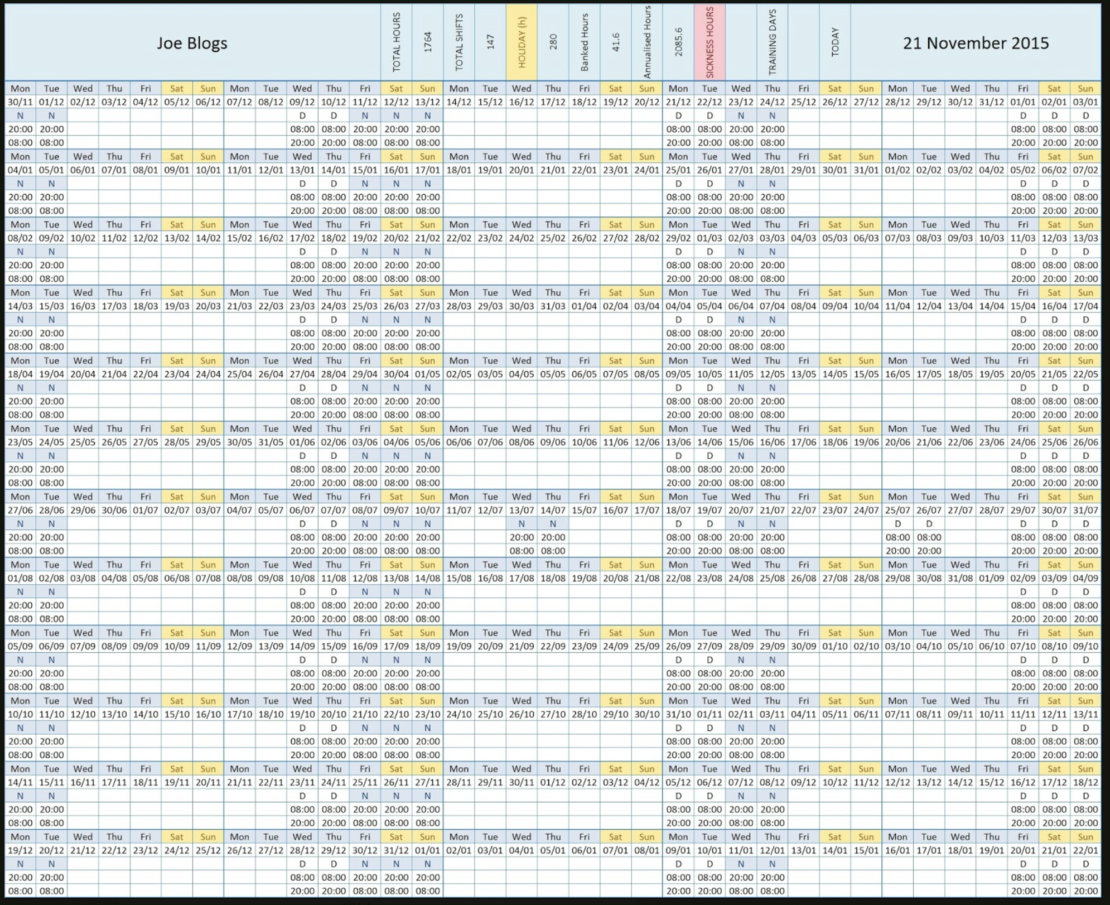
And if you were wondering what the best holidays included shift pattern looks like, then it’s the 554. On the 554 holidays included you can work four or five shifts and have a week off. Here is an example of the 554 holidays included. This is a typical shift pattern that you would work as a full time equivalent on 12-hour shifts.
On this version you get about 29 weeks off. In the summer the shifts have been changed so you give up two normal weeks off and get an 18-day break.
Oh and if you don’t like your weeks off, then you can swap shifts, so that you can tailor your shift pattern to your own life style.
If you want to introduce a holidays included shift pattern to your department, tell your manager about C-Desk Technology and direct them to our website at www.oranalysts.com or email at alec@oranalysts.com or our book explaining a holidays included shift pattern is available on Amazon
UK Amazon
US Amazon

Christmas Party
When it comes to Christmas there is always lots going on. It’s a time for families and friends to get together and celebrate the ending of one year and the beginning of the next. So everyone likes to get Christmas off. Many businesses close for Christmas, they have a Christmas shutdown. But not all companies can do this, and not all departments enjoy a Christmas shutdown.
Essential operations, like hospitals, police, security, fire, ambulance, news, TV, power stations, phones, call centres, restaurants, hotels etc. cannot close over Christmas. Some can’t even go down to a skeleton crew.
So companies operate shift systems that go over the Christmas period and have special Christmas rotas. These allow some people to be off at Christmas and it rotates so if you work Christmas one year you get it off the next etc.
The Snow Queen's table photographed at
Waddesdon Manor
Waddesdon Manor
But then there is the Christmas Party. Every company, or department like to have a little get together. Unfortunately a business that doesn’t stop for Christmas, won’t be able to stop for a party. So how do you get everyone to the party?
- You could have two parties
- Ask for volunteers to work
- Give people a bonus for working and missing the party
- Give people a day off in lieu for working that day and missing the party
- Hold it over a shift handover time. E.g. party starts at 5pm till midnight with a shift change at 8pm every one can go to half
- Alternate years so if you go one year you have to work the next
- You could even think out of the box, so have a celebration at work and encourage your staff to invite their families. Then have everyone alternate between celebrating and working. Or if you can’t have visitors on site, why not set up a video link in the break room so that your staff can chat to people at the party during their breaks.
Christmas is coming,
The Goose is getting Fat,
Have you put you name in the Old Man’s Hat?
If you’ve off for Christmas, Lucky Old You!
If you stuck working, God Bless You!
Enjoy!

Ada Lovelace Day
I celebrated Ada Lovelace day by working on a difficult logic problem. If someone is on a holiday’s included shift pattern for part of the year and then moves off internally to a holidays excluded pattern, how much holiday do they have left to take?
It may sound easy but the logic was quite daunting. The shift pattern accounted for their hours and basic holiday. Then they could take additional holiday while on shift if they were entitled to more than their basic. Plus they could swap shifts and training was in addition. Oh and they also did overtime too. So all in all a very typical shift operation designed for ideal circumstances and then continually adapted to fit the changing environment.
So pro rata estimates were invalid because the shift pattern did not remain continuous for the whole year. Hence I had to take the recorded hours they had worked, then the holiday they had taken into account plus the hours they were due to be scheduled on when they moved off the shift pattern. So a lot of maths later I had a logically sound answer.
So how much holiday would you give a person who is on a 37.5 hour week, and is due to be moved off the rota on 1st December? He is entitled to 30 days of holiday plus Bank Holidays. The rota accounted for only 30 days during the year. He has worked 1580 hours (or scheduled to work including sickness) up until 1st December. Then he moves onto an office shift pattern. He has also had 37.5 hours of training and taken 24 hours of holiday in addition to the holidays included shift pattern.
So what’s the answer?
Well first we need to know how many hours he will be scheduled to work on an office shift pattern. There are four weeks and three days in December. So that would be 172.5 hours.
Then we work out how many hours he should have been scheduled for during the year. 1,955.25 hours.
He has worked 1,641.5 up until 1st December.
So the holiday that was included in the rota was 1,955.25-1,641.5-172.5=141.25 hours
So he was entitled to 285 hours of holiday during the year. He has taken 24 hours and been scheduled for 141.25 hours of holiday. Therefore logically he is entitled to 119.75 hours of holiday in December. There are two Bank Holidays in December so that takes care of 15 hours of holiday (two days of 7.5-hours). But that still leaves 104.75 hours or 11 days.
That is half of December!
So your options are,
- Force him to take holiday before moving to the new post
- Schedule him to be off on some shifts before December
- Pay overtime
- Carry over holiday
- Buy back the holiday
You may be asking how the answer could be so high. Well it’s a holiday included shift pattern. So while over the year he would have worked the correct number of hours, you have to allow for him being rostered off for more time during part of the year. So because he is being removed mid cycle his hours do not represent an average amount.
So swapping people on and off a holidays included shift pattern mid cycle could leave you with high overtime bills!
If you need help working out staffing costs or shift pattern drop us an email at alec@visualrota.co.uk or call on +44 (0) 1636 816466

Christmas Rota
There’s just 10 Fridays to go before Christmas!
The Snow Queen's table photographed at
Waddesdon ManorSo have you given any thought to whom will be on your Christmas Rota?
Waddesdon ManorSo have you given any thought to whom will be on your Christmas Rota?
Working at Christmas is a necessary requirement for many organisations but it needs special management, which is why we often recommend that companies employ a special Christmas Rota.
Christmas is a time for families to get together and add cheer to the long winter months. So everyone wants to have some time off during the holiday season. You can’t give everyone the same time off unless you close up your business with a shutdown. But how do you say no to that holiday request? Who do you say yes to and how do you justify your answers?
Christmas is a time for families to get together and add cheer to the long winter months. So everyone wants to have some time off during the holiday season. You can’t give everyone the same time off unless you close up your business with a shutdown. But how do you say no to that holiday request? Who do you say yes to and how do you justify your answers?
Being a manager is not easy. You have to have patience, be seen to be fair, make the hard choices and stick by them as well as doing the job you are paid to do. You can never be liked by everyone and people’s opinion of you will be swayed by your next decision depending on if it is in their favour or against them.
So don’t let personal feelings cloud your judgment. Make up a set of rules which cover nearly every eventuality you can think of. Make sure everyone is aware of what you will and will not allow and stick to it. That way you will not always be liked but everyone will always say you dealt fairly with them.
When it comes to allowing holidays it is even more important to judge everyone the same and not let personal bias effect your judgment. So you set up rules like first come first served. Plan ahead how many of each skill you will allow off at any time or how you will cover missing skills. Set up the rules before any holiday requests are made. If you need help setting up your rules then read our book Holiday Management available from Amazon UK and from US Amazon
A Christmas Rota is a great way of organising your employees. This means that you can control who works Christmas and who doesn't. So in order to be fair you set it up for two years at a time (sometimes we do it for as many as 10 years), therefore if a person worked Christmas last year, they will not have to work it this year etc. Also if they work Christmas then they get New Year off and vice versa. This is often contentious, and therefore you need a fair and equitable system.
The advantages of a Christmas Rota, are:
- You can equalise everyone's hours,
- You can equalise everyone's shifts,
- You can equalise everyone's nights,
- You can have better control of holidays,
- Better cross team communication,
- Opportunity to equalise payments,
- Opportunity to swap teams,
- Equalise skills, and provide an equal level of service over the holiday period.